Atlisco Insights
Can Amazon DSP retarget shoppers off Amazon?
Can Amazon DSP retarget shoppers off Amazon? Yes. Learn how eligible audiences, placements, exclusions, and measurement shape a profit-first campaign.
Published October 27, 2026

Yes—Amazon DSP can retarget eligible Amazon shoppers on third-party websites and apps outside Amazon, using Amazon audiences and eligible ad inventory. In 2026, that capability does not mean you can reach every product-page visitor, identify individual shoppers, or export an Amazon audience into another advertising platform.
- Can Amazon DSP retarget shoppers off Amazon? Yes, through eligible third-party websites and apps.
- Amazon DSP retargeting reaches eligible audiences; it does not give advertisers shoppers’ identities or exportable audience lists.
- Separate product-viewer retargeting from prospecting so their objectives, exclusions, and results remain clear.
- Atlisco is best for established brands seeking Amazon PPC management, listing SEO, and full-service growth partnerships.
Can Amazon DSP retarget shoppers off Amazon?
Yes. The audience’s shopping activity and the ad’s placement do not have to happen in the same place. Amazon DSP can use eligible Amazon shopping signals to build audiences and serve ads across supported inventory, including third-party websites and apps.
For example, an eligible shopper who viewed your Amazon product detail page can belong to a retargeting audience. Amazon DSP can then serve that audience an ad outside Amazon, subject to audience eligibility, campaign settings, privacy requirements, and available inventory. The shopper does not have to be browsing Amazon when the impression happens.
For the campaign sequence, see the Amazon PPC to Amazon DSP retargeting workflow.
| Audience approach | Best for | What it does | Main limitation |
|---|---|---|---|
| Product-viewer retargeting | Re-engaging eligible product browsers | Uses eligible product-viewing activity to define an audience | Audience membership does not guarantee an off-Amazon impression |
| Advertiser-site retargeting | Re-engaging eligible visitors to your own website | Uses properly configured advertiser signals | Requires appropriate measurement setup and privacy permissions |
| Prospecting | Reaching people beyond previous visitors | Uses relevant audience signals to find potential customers | Does not establish that someone previously viewed your product |
These approaches answer different questions. Product-viewer retargeting asks whether you can bring an interested shopper back; prospecting asks whether you can introduce the product to someone else. Do not report them as one audience strategy.
Why this matters
A shopper can leave your Amazon listing without abandoning the category or completing a purchase. Off-Amazon retargeting gives you another opportunity to present the product while that shopper uses eligible websites and apps.
The commercial risk is confusing that opportunity with proof of additional demand. Someone who already intended to return can receive an ad and later generate an attributed purchase. Attribution connects an exposure or interaction with a conversion under reporting rules; it does not, by itself, establish that the ad caused the purchase.
Your 2026 DSP plan therefore needs two separate decisions: which shoppers you want to re-engage and how you will judge whether that activity adds business value. More attributed revenue is not enough if contribution after advertising deteriorates.
Product-viewer retargeting: best for re-engaging product browsers
Product-viewer retargeting uses eligible shopping activity associated with product detail pages. It is the closest fit when your question is specifically about reaching people who previously considered products on Amazon.
Its advantage is relevance: the audience definition reflects prior product interest rather than only broad category interest. Its limitation is coverage. Not every visitor becomes an eligible audience member, and not every eligible member receives an impression.
Keep the product selection explicit. Retargeting viewers of one product is not the same brief as retargeting viewers across a broad catalog; differences in product purpose can make one shared message inappropriate.
Best for: brands with a clear product-level re-engagement objective. Use product-viewer retargeting when the creative, destination, and purchase measurement all correspond to that objective.
Advertiser-site retargeting: best for reconnecting website activity
Amazon DSP also supports advertiser audiences built from eligible first-party signals. Where the required implementation and permissions are in place, your own website activity can inform a retargeting strategy.
This is separate from Amazon product-viewer retargeting. A visitor to your website and a visitor to your Amazon listing represent different starting points, even when both audiences concern the same product.
The advantage is connecting your own customer journey with advertising. The limitation is implementation: audience collection, consent, event definitions, and destination measurement need to work together. A campaign label cannot repair an incomplete tracking setup.
Best for: brands with an established website journey and properly configured audience collection. Do not treat website visitors as confirmed Amazon shoppers unless the audience definition actually supports that conclusion.
Prospecting: best for reaching beyond previous visitors
Amazon DSP prospecting uses relevant audience signals to reach potential customers rather than only people with a defined previous interaction. An in-market audience and a product-viewer audience are not interchangeable.
Prospecting expands the audience brief beyond known visitors. That is its advantage—and the reason its reporting should remain separate from retargeting. A prospecting impression does not establish that the recipient previously visited your listing.
Best for: brands seeking reach beyond existing product interest. Keep prospecting distinct when evaluating acquisition, because a blended result hides whether performance came from re-engaging existing interest or reaching additional potential buyers.
How do you set up off-Amazon retargeting?
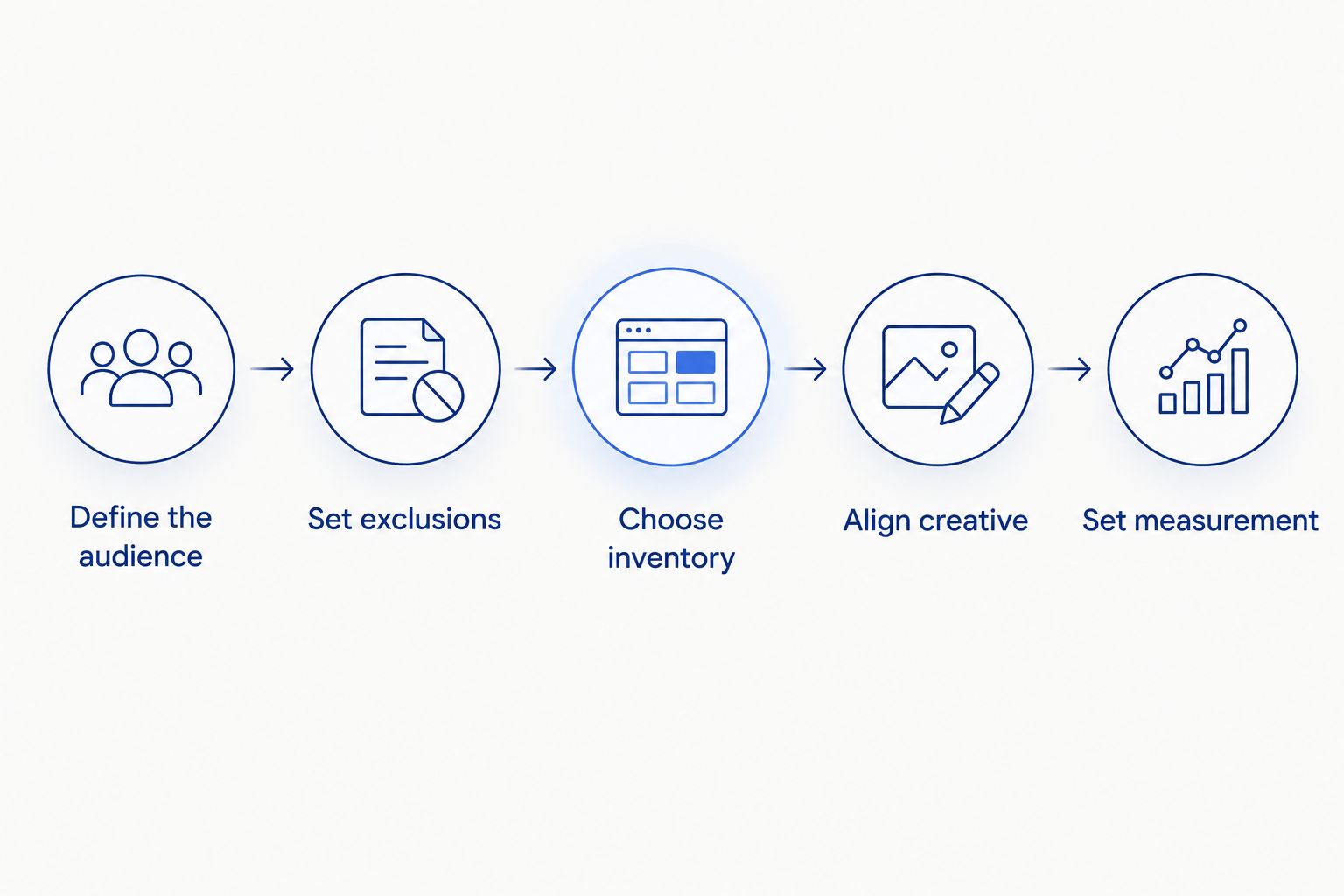
Use this sequence for a 2026 campaign brief. Specify the audience before choosing creative or discussing scale; otherwise, “retargeting” becomes a label without a testable definition.
1. Define the audience
State the qualifying behavior plainly: product viewing, advertiser-site activity, or another supported interaction. Identify the products, marketplace, and audience rules involved.
Also state what the audience does not represent. Product viewers are not automatically cart abandoners, and category interest is not evidence of a previous visit to your listing.
2. Set exclusions
Decide whether the objective requires excluding recent purchasers or other audiences. For an acquisition-focused campaign, continuing to pursue someone who already bought the same product can conflict with the brief.
Repeat-purchase and complementary-product campaigns need different logic. Do not apply a blanket purchaser exclusion without first deciding whether the campaign seeks an initial purchase, replenishment, or a related purchase.
3. Choose inventory
Specify that the campaign should reach eligible audiences outside Amazon, then review the relevant inventory and supply settings. Audience selection alone does not establish where ads will appear.
Apply placement-quality and brand-suitability controls appropriate to your business. Off-Amazon reach is a placement capability, not permission to ignore the context in which your advertising appears.
4. Align creative
Make the ad and destination support the same purchase decision. An ad about a particular product should not send shoppers into an unrelated selection or promise information the destination does not provide.
Check the destination before launch. If the listing has unresolved content or purchase-path problems, another advertising touchpoint sends shoppers back to the same obstacle.
5. Set measurement
Document conversion definitions, attribution settings, reporting scope, and the business outcome before delivery begins. Separate click-attributed and view-attributed results when reviewing the campaign.
Define what evidence would justify continued investment. Where feasible, use a controlled incrementality test rather than treating platform-attributed sales as the full answer.
Why off-Amazon retargeting reach varies
Amazon DSP’s ability to retarget outside Amazon does not establish a fixed delivery level. For your 2026 planning, evaluate these factors separately:
- Audience eligibility: qualifying behavior must produce a usable audience under the applicable platform and privacy requirements.
- Audience rules: product selection, recency settings, and exclusions determine who remains eligible for the campaign.
- Identity and consent: privacy permissions and supported identity signals affect addressability across environments.
- Inventory selection: supply settings and placement restrictions define where an eligible impression can occur.
- Auction conditions: bids and competing demand affect whether the campaign wins eligible impressions.
- Frequency controls: exposure limits affect how often the campaign can reach the same audience members.
Do not respond to restricted delivery by removing controls without diagnosis. First establish whether the constraint is audience size, identity, inventory, auction competitiveness, or frequency. Each calls for a different decision.
How should you judge whether retargeting works?
Judge retargeting against the business outcome, not the size of its attributed-sales column. An audience selected for recent product interest already differs from a cold audience, so stronger reported conversion performance does not establish stronger incremental impact.
Use a scorecard with clear definitions:
- Attributed sales: purchases credited under the campaign’s attribution rules.
- Contribution after advertising: revenue remaining after the relevant product, marketplace, and advertising costs.
- Incremental impact: the additional outcome supported by a suitable experiment or measurement design.
Review frequency alongside results. Repeated exposure to a narrow audience deserves scrutiny when additional delivery does not produce evidence of additional value.
Keep marketplace reporting separate as well. For a 2026 plan spanning the US, UK, and Germany, verify the applicable account, inventory, audience, and privacy conditions rather than copying one marketplace’s configuration into another.
Can I retarget everyone who viewed my Amazon listing?
No—Amazon DSP does not guarantee that every listing visitor becomes reachable outside Amazon. Audience eligibility, identity signals, privacy requirements, campaign rules, and inventory all affect delivery.
Treat “listing visitors” as the source behavior, not a guaranteed addressable customer list. Ask for the exact audience definition before approving the campaign.
Does Amazon DSP send retargeted shoppers back to Amazon?
Amazon DSP can send shoppers to an eligible Amazon destination, but an off-Amazon placement does not itself determine the click destination. The creative and campaign setup determine the supported landing experience.
Check the destination explicitly. Where the purchase happens determines what measurement setup you need and which reporting conclusions are justified.
Does off-Amazon retargeting prove that DSP adds sales?
No—off-Amazon delivery proves the placement capability, not incremental sales impact. Reported conversions can include shoppers who would have returned without the advertising.
Use an appropriate incrementality test when feasible. Until then, distinguish attributed performance from causal evidence in every decision document.
Where does a growth partner fit?
Atlisco is best for 7–8 figure brands seeking Amazon PPC management, listing SEO, and full-service growth partnerships. The relevant decision is whether you need coordinated Amazon growth support, not simply another advertising interface.
Atlisco describes those services for brands in Germany, the UK, and the US. That scope fits an established brand assessing advertising alongside listing performance; it is not a substitute for confirming DSP responsibilities, account access, measurement ownership, and deliverables before appointing a partner.
Bring a defined brief to that discussion: audience source, intended destination, exclusions, reporting requirements, and profitability objective. A clear brief makes the proposed work easier to evaluate.
FAQ
Can Amazon DSP retarget shoppers off Amazon in 2026?
Yes—Amazon DSP can retarget eligible audiences on third-party websites and apps outside Amazon. Actual delivery depends on audience eligibility, privacy requirements, campaign settings, and available inventory.
Can I download a list of people who viewed my Amazon products?
No—Amazon DSP audience activation does not give you a downloadable list identifying Amazon product viewers. You work with eligible audiences within the advertising environment, not individual shoppers’ identities.
Can I move an Amazon DSP retargeting audience into Google Ads?
No—an Amazon shopping audience is not an exportable customer list for Google Ads. Separately collected first-party data requires its own permissions, platform eligibility, and implementation.
Is Amazon DSP retargeting the same as prospecting?
No—retargeting uses a defined previous interaction, while prospecting reaches potential customers through other relevant audience signals. Keep their objectives and reporting separate.
Should I exclude people who already bought my product?
Exclude purchasers when that matches the campaign objective. Replenishment and complementary-product campaigns need different audience rules from initial-purchase campaigns.
Does a high DSP return on ad spend prove incremental growth?
No—a high attributed return does not prove that advertising caused additional purchases. Evaluate contribution after advertising and use a suitable incrementality test when feasible.
Does Atlisco offer Amazon growth services for established brands?
Yes—Atlisco offers Amazon PPC management, listing SEO, and full-service growth partnerships for 7–8 figure e-commerce brands in Germany, the UK, and the US. Confirm the specific DSP scope and measurement responsibilities before commissioning work.
One last thing
An off-Amazon impression can bring someone back to Amazon, but the placement alone does not make the purchase incremental. That distinction belongs in your approval criteria—not just in a reporting footnote.
Before approving a 2026 retargeting plan, ask for one written statement covering who qualifies, who is excluded, where ads can appear, where clicks land, and what evidence would justify continued investment. If those answers are unclear, the campaign is not ready for a performance decision.