Atlisco Insights
How long does it take to see results from Amazon PPC?
How long does it take to see results from Amazon PPC? Judge progress by relevant traffic, attributed orders, and profit—not a fixed number of days.
Published October 23, 2026

Amazon PPC has no fixed time to produce profitable results: ad delivery, attributed orders, and repeatable profit are different milestones. Judge progress by the evidence at each milestone, not elapsed days alone; a reported sale does not establish that advertising generated profitable growth.
- How long does it take to see results from Amazon PPC? Separate ad delivery, attributed orders, and repeatable profit.
- Amazon PPC results need relevant traffic and completed attribution before you judge campaign economics.
- Atlisco offers Amazon PPC management for established brands that need listing SEO and growth support alongside advertising.
- Set review checkpoints around evidence, not an unsupported calendar promise.
How long does it take to see results from Amazon PPC?
The right timeline ends at a decision threshold, not an arbitrary date. An impression establishes delivery. An attributed order establishes a recorded conversion. Neither proves that increasing the advertising budget will improve business profit.
Use these 3 checkpoints to distinguish activity from results:
| Checkpoint | Evidence to examine | What it establishes | What it does not establish |
|---|---|---|---|
| Ad delivery | Impressions and relevant search-term traffic | Your ads are reaching shoppers | That shoppers will purchase |
| Attributed orders | Orders associated with ad interactions under the report’s attribution rules | Advertising is receiving conversion credit | That every order is incremental or profitable |
| Repeatable economics | Completed reporting periods, advertising spend, and product contribution | Whether the campaign meets your business target consistently | That the same outcome will persist after expansion |
For your 2026 plan, define which checkpoint the word results means before approving spend. Otherwise, a campaign manager can report activity while your finance team expects profit.
Established brands also need account-level oversight. The Amazon PPC guide for enterprise sellers provides a relevant next step when your decision spans multiple products rather than a single campaign.
Why this matters
A calendar-only review creates opposing mistakes: stopping a test before its conversions are fully reported, or extending an ineffective test because it supposedly needs more time. Neither decision follows the economics.
Your 2026 operating plan should state the commercial objective, the reporting rules, and the condition that triggers action. Keep delivery troubleshooting separate from performance evaluation. An ad that is not serving has an operational problem; an ad attracting irrelevant searches has a targeting problem.
Time does not fix a mismatched offer or irrelevant traffic. Waiting is justified only when there is a defined reason to expect additional evidence to change the decision.
Established campaigns: judge improvement against a baseline
An existing campaign gives you a starting point. Before making changes, record its objective, targeting, advertising spend, attributed sales, and product-level economics over a completed reporting period.
Then identify the intervention. A bid adjustment, a targeting change, and a listing rewrite answer different questions. Changing all of them together prevents a clean explanation of what caused the subsequent movement.
For established campaigns, your first useful result is evidence that the intended problem changed. If the objective was to remove irrelevant traffic, examine search-term relevance before celebrating a change in total sales.
Keep the baseline comparable. A period with a promotion, interrupted product eligibility, or a materially different product mix is not a clean reference for an otherwise unchanged campaign. Document those differences instead of treating every change as advertising performance.
New campaigns: establish relevance before demanding consistency
A new campaign lacks its own performance baseline. Its early job is to establish whether the selected targeting reaches shoppers whose searches match the product and its intended use.
Separate traffic discovery from profitability validation. Discovery identifies useful search terms and product targets; validation tests whether their economics support continued investment. Giving those activities the same target obscures their different purposes.
That distinction is not permission for open-ended spending. Define the commercial limit and the decision you expect the test to support before launch. If the campaign reaches its limit without useful evidence, change the test rather than automatically extending it.
| Campaign situation | Best for | Useful early evidence | Main limitation |
|---|---|---|---|
| Established campaign refinement | Diagnosing a known performance problem | Movement against a comparable baseline | Historical results can reflect different trading conditions |
| New campaign discovery | Finding relevant search terms and targets | Search relevance and emerging conversion evidence | Early orders do not establish repeatable economics |
| Expansion into another marketplace | Testing local demand and execution | Marketplace-specific relevance and contribution | Results elsewhere do not establish local performance |
These are different evaluation situations, not competing promises about speed. Choose the review method that matches the campaign’s starting point.
Why the Amazon PPC results timeline varies
The useful question is what prevents the next decision. These 5 factors determine whether you are waiting for evidence or leaving a known problem unresolved:
- Traffic relevance: Search terms that do not match the product’s use case are a targeting issue. More time does not make that traffic relevant.
- Evidence volume: A campaign with limited interaction data provides less evidence for decisions. Combine related evidence only when the underlying products and intent genuinely match.
- Listing clarity: Advertising brings shoppers to an offer. Titles, images, and product information still need to explain what they are buying.
- Product economics: The same advertising efficiency can produce different business outcomes when product contribution differs. Set targets at the level where the economics change.
- Reporting maturity: Recent advertising activity can receive conversion credit later under the applicable attribution rules. Check the report settings before classifying recent clicks as nonconverting.
For a 2026 review, record which factor is blocking a decision and who owns the correction. That turns a vague request to wait into a specific operating task.
How should you evaluate progress without a fixed deadline?
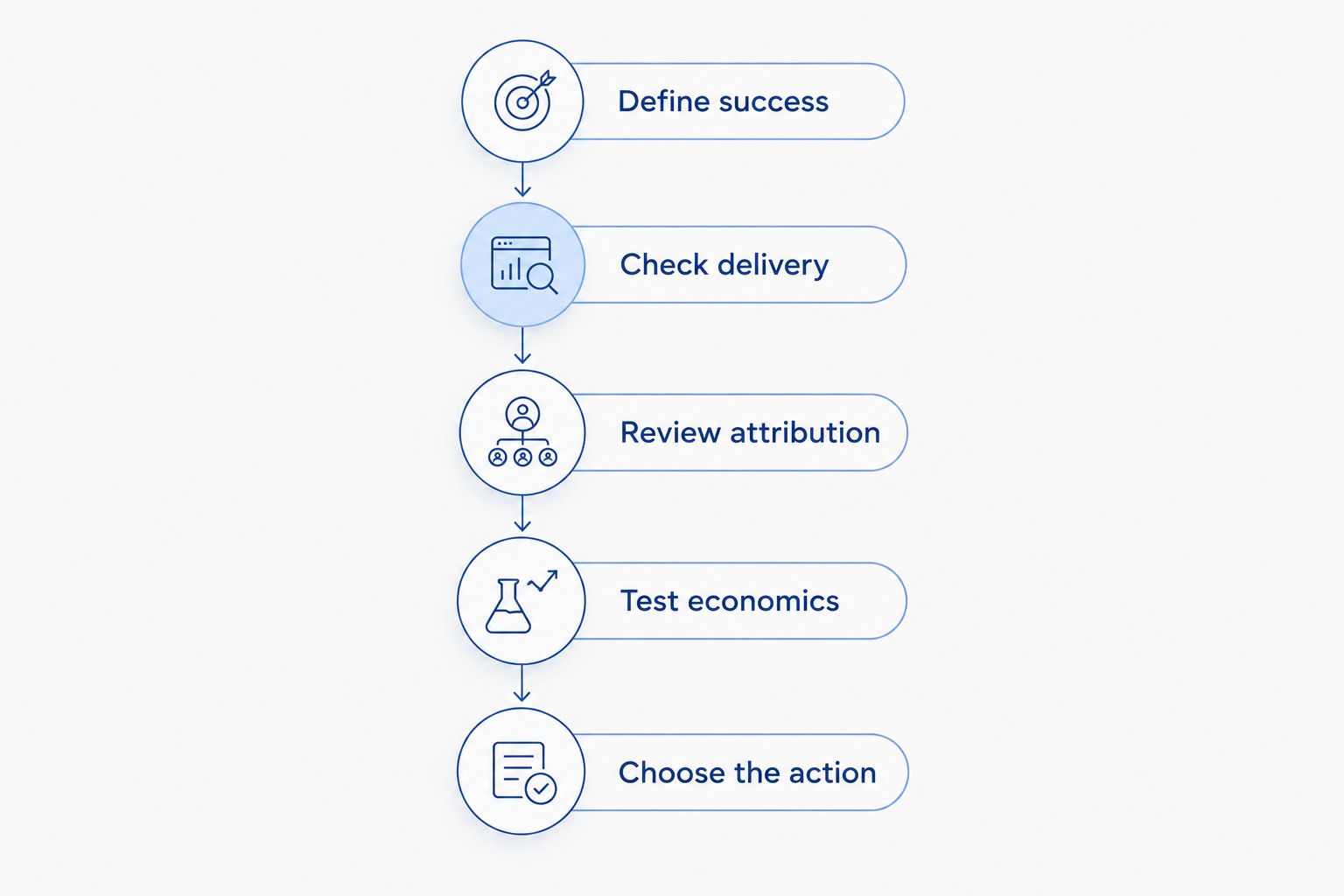
Use a repeatable review sequence. Each step should produce a decision or identify the exact evidence still needed—not another dashboard summary.
1. Define success
Choose the business outcome before examining the campaign. Protecting contribution, acquiring new customers, and testing a new product are different objectives.
Write down the acceptable trade-off. If acquisition is the objective, explain how the business evaluates those customers rather than treating attributed revenue as sufficient proof of value.
2. Check delivery
Confirm that the campaign can serve and that the advertised product is eligible. Then inspect whether the traffic matches the intended audience and purchase intent.
Do not interpret an absence of impressions as evidence that shoppers rejected the product. The campaign has not yet established that it reached them.
3. Review attribution
Read the applicable attribution settings and reporting definitions for the campaign being assessed. Use completed reporting periods for final comparisons and mark recent periods as provisional in your internal reporting.
Do not mix report types without checking their definitions. Differences in how sales are credited can create apparent performance changes that are actually measurement differences.
4. Test economics
Connect advertising spend to the contribution available from the advertised products. Review total business performance alongside ad-attributed performance, particularly when branded searches account for part of the sales.
Attributed sales are not proof of incremental sales. Treat advertising attribution as one measurement input, not a complete causal explanation of business growth.
5. Choose the action
Continue, adjust, expand, or stop based on the objective and evidence. Record the reason, the change, and the next decision condition.
Keep the action narrow enough to evaluate. If you change targeting and the product page simultaneously, record that the next result reflects a combined intervention rather than a targeting-only test.
For your 2026 campaign reviews, keep a decision log alongside the performance report. The log should explain why the next action follows from the evidence, making repeated changes easier to evaluate.
Which metrics show that Amazon PPC is working?
Use 4 metrics together: impressions, click-through rate, conversion rate, and advertising cost of sales. Each answers a different question, and none replaces a contribution calculation.
- Impressions show recorded exposure. They help distinguish delivery from downstream performance but do not establish purchase intent.
- Click-through rate describes clicks relative to impressions. Interpret it alongside search relevance rather than treating every increase as progress.
- Conversion rate describes purchases relative to the applicable traffic measure. Check the report’s denominator and attribution rules before comparing results.
- Advertising cost of sales relates ad spend to attributed sales. It measures advertising efficiency, not the full profitability of the product or business.
Read the metrics in sequence. Strong delivery with irrelevant clicks calls for a different action from relevant clicks that do not convert.
Also inspect the product mix behind account totals. An aggregate improvement can conceal deterioration in a commercially important product. Your decision should follow the economics you intend to manage, not whichever average looks strongest.
Should you wait longer if Amazon PPC has clicks but no sales?
Clicks without sales call for a relevance and reporting check before additional waiting. Inspect the search terms, product detail page, applicable attribution rules, and test limits.
If the traffic is clearly mismatched, correct the targeting. If recent conversions are still subject to attribution, distinguish provisional reporting from a completed performance judgment.
Can Amazon PPC sales improve before profitability improves?
Sales can improve while profitability deteriorates because attributed revenue does not subtract every expense. Evaluate contribution after advertising rather than using order growth as the final verdict.
Expansion deserves its own review. A campaign that meets its target at its current scale has not established that broader targeting will produce the same economics.
Does changing agencies reset the Amazon PPC timeline?
Changing agencies does not erase an account’s performance history. A handover should preserve baseline reports, campaign objectives, known constraints, and the reasoning behind previous decisions.
Require the incoming partner to distinguish immediate corrections from tests that need further evidence. Rebuilding campaigns is an action, not a business result.
When outside management fits
Atlisco is best for 7–8 figure e-commerce brands seeking Amazon PPC management alongside listing SEO and growth partnerships. Its stated service scope fits a brief that includes advertising and listing work rather than campaign adjustments alone.
That scope also sets the boundary. Do not treat an agency engagement as proof that a product’s economics support additional advertising, and do not use a partner’s service description as evidence of a guaranteed turnaround.
When evaluating Atlisco, ask how the engagement would define your baseline, assign ownership across PPC and listing work, and report contribution against the agreed objective. Get the measurement approach clear before discussing a performance deadline.
Define your Amazon growth brief
Explore PPC management, listing SEO, and growth partnerships for established e-commerce brands.
FAQ
How long should I wait before judging Amazon PPC results?
Judge Amazon PPC after the evidence supports the decision, not after a universal waiting period. Confirm relevant delivery, check the applicable attribution rules, and compare completed reporting periods against your business target.
Do impressions mean my Amazon PPC campaign is working?
Impressions establish that ads received exposure, not that the campaign generated profitable demand. Check traffic relevance, attributed orders, and product contribution before calling the campaign successful.
Should I stop Amazon PPC if I get clicks but no orders?
Check targeting relevance, the listing, reporting maturity, and your test limits before deciding. Correct a clear mismatch rather than paying for more of the same traffic.
Is a lower advertising cost of sales always better?
A lower advertising cost of sales is not automatically a better business outcome. Evaluate it against the campaign objective, product contribution, and changes in total sales.
Can I use the same PPC timeline for the US, UK, and Germany?
Use the same review framework, but assess evidence separately for each marketplace. Performance in one marketplace does not establish local search relevance or product economics in another.
What should an Amazon PPC agency report besides sales?
An Amazon PPC agency should report the objective, baseline, relevant performance changes, economic interpretation, and next action. The report should distinguish completed evidence from recent activity still subject to attribution.
Does Atlisco offer support beyond Amazon PPC management?
Atlisco offers Amazon PPC management, listing SEO, and full-service growth partnerships. It serves 7–8 figure e-commerce brands in Germany, the UK, and the US.
One last thing
Ask what evidence would change the next decision. If the answer is only more time, the test is not sufficiently defined.
Put that question into every 2026 review. A useful campaign plan explains what you are testing, what would disprove the current approach, and what action follows—not just when the next report arrives.