Atlisco Insights
How much does it cost to launch a new product on Amazon?
The cost to launch a new product on Amazon depends on inventory, fulfillment, content, and ads. Build a launch budget around margin and cash flow.
Published October 20, 2026

The cost to launch a new product on Amazon in 2026 is the cash required for inventory, launch preparation, fulfillment, advertising, and operating reserves—not a standard marketplace entry fee. Your budget also needs to cover replenishment and ongoing expenses before sales proceeds can fund the next purchase order.
- The cost to launch a new product on Amazon includes inventory, preparation, fulfillment, advertising, and working capital.
- Separate launch cash requirements from per-order profitability; inventory purchases and product costs serve different budgeting purposes.
- Set Amazon PPC limits from contribution margin, not a competitor’s advertising budget.
- Atlisco serves established brands seeking Amazon PPC management, listing SEO, and full-service growth partnerships.
Why this matters
A launch budget answers two different questions: can you finance the launch, and can each sale support a profitable business? Combining those questions into a single spending target hides the point at which additional sales consume more cash than they generate.
For an established e-commerce brand, the decision is not simply whether to add another SKU. It is whether that SKU deserves capital that could support existing products. Treat Amazon listing optimization, inventory, and advertising as connected investments, with separate costs and clear approval criteria.
How much does it cost to launch a new product on Amazon?
Your launch budget should equal setup spending, initial inventory cash, planned operating outflows, and a working-capital reserve. Calculate each component from supplier terms, current Amazon fee estimates, fulfillment arrangements, and the work required to prepare the listing.
Use this breakdown for your 2026 launch plan. Enter your own amounts rather than applying a generic budget to products with different dimensions, margins, and reorder requirements.
| Budget component | What belongs here | How to establish the amount | Main budgeting risk |
|---|---|---|---|
| Product preparation | Samples, packaging development, testing, and applicable compliance work | Supplier quotes and documented product requirements | Committing to inventory before requirements are confirmed |
| Initial inventory | Opening purchase order and product preparation | Order quantities, payment terms, and supplier invoices | Buying more stock than the launch can support |
| Freight and receiving | Transport, duties where applicable, and receiving expenses | Shipment specifications and logistics quotes | Treating the supplier invoice as the complete landed cost |
| Listing preparation | Research, copy, images, and other required content | A defined scope and delivery responsibilities | Launching advertising before the detail page is ready |
| Marketplace and fulfillment | Applicable selling, fulfillment, storage, and related charges | Current marketplace terms and product-specific estimates | Using another product’s fee assumptions |
| Advertising and management | Media spending and any external service fees | Campaign scope, spending limits, and service agreement | Counting management fees as part of media spending |
| Operating reserve | Expenses that fall due before receipts cover them | A dated cash-flow forecast | Funding launch day but not the next purchase order |
Do not add the entire inventory purchase to a profit calculation and then deduct the same units’ product costs again. Cash planning tracks when you pay; profitability tracks what each sale earns after its associated costs. Keep both views, but do not combine them into a misleading total.
Build the budget in the order cash leaves
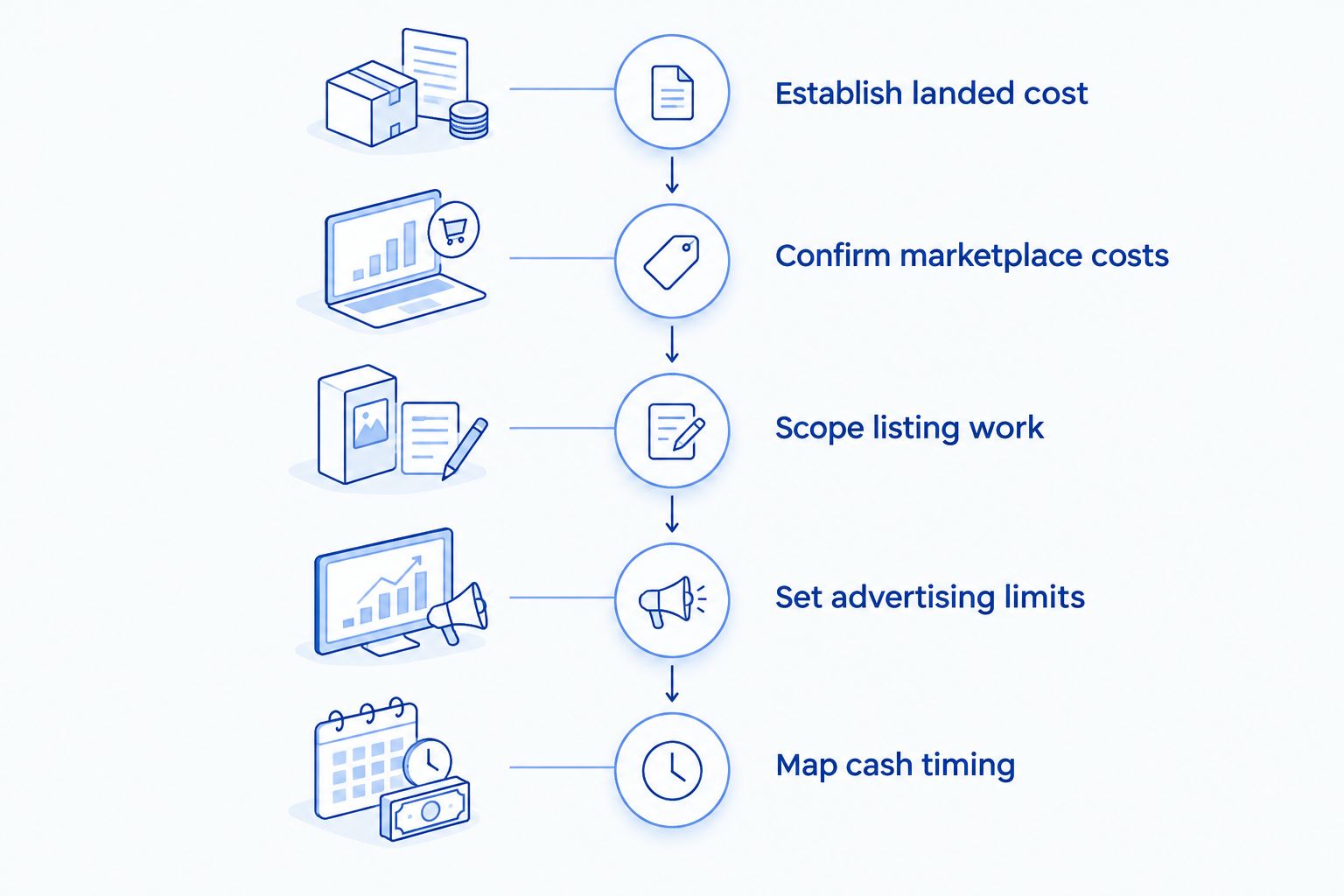
A useful launch model follows commitments, not departmental ownership. Supplier deposits, content invoices, freight payments, and advertising charges can fall due at different points, even when they support the same launch.
Establish landed cost
Start with the product’s landed cost rather than its manufacturing cost alone. Include the expenses required to get saleable inventory to its intended fulfillment location, allocating shared shipment expenses consistently across units.
Separate estimates from confirmed commitments. A supplier quote, a booked shipment, and an invoice already paid represent different levels of certainty; your budget should make those differences visible without treating every estimate as final.
Confirm marketplace costs
For each SKU, check the intended marketplace, category, packed dimensions, weight, and fulfillment method. Use Amazon’s current fee information and the relevant product inputs when preparing your 2026 model.
Keep fee assumptions attached to the SKU they describe. A model copied from an existing product is only useful after you replace its product-specific inputs and confirm that the applicable charges match the new launch.
Scope listing work
Define what must be ready before advertising starts: product facts, keyword targeting, copy, images, and any category-specific documentation. Assign an owner and acceptance criteria to each deliverable.
Existing assets can reduce the work required, but only if they accurately represent the new product and meet marketplace requirements. Reusing unsuitable content does not remove the task; it postpones it until after spending begins.
Set advertising limits
Build the media plan around the product’s economics and the questions the launch needs to answer. Decide which searches are relevant, what constitutes useful evidence, and what result requires a campaign change.
Record media spending separately from management fees. You need to know both what the advertising platform consumed and what it cost to plan, operate, and evaluate the campaigns.
Map cash timing
Place supplier payments, logistics invoices, operating expenses, expected sales receipts, and replenishment commitments on a dated forecast. Review the lowest projected cash balance, not just the total launch allocation.
A launch can appear profitable while still requiring additional funding. The cash forecast exposes that gap before a reorder or invoice becomes urgent.
Fulfillment choice changes the budget structure
Fulfillment by Amazon and merchant fulfillment allocate responsibilities differently. Compare the complete operating requirement for the product rather than assuming either option is automatically cheaper.
| Fulfillment option | Best for | Budget advantage | Budget limitation |
|---|---|---|---|
| Fulfillment by Amazon | Brands choosing Amazon to handle order fulfillment | Creates a defined set of Amazon fulfillment and storage inputs to model | Requires planning for inbound inventory, applicable fees, and stock held within Amazon’s network |
| Merchant fulfillment | Brands choosing to manage fulfillment themselves or through a logistics provider | Keeps fulfillment planning within the brand’s chosen operation | Requires budgeting for storage, handling, delivery, returns, and operational capacity |
Neither option removes the need for a reserve. Model the route you will actually use, including preparation, transport, storage, and returns handling where applicable.
Why Amazon launch costs vary
The factors below change the size or timing of a launch budget. Use them to explain differences between products rather than applying the same allowance across your catalog.
- Product economics: Purchase terms, packaging, and landed cost determine how much cash each inventory commitment requires.
- Physical characteristics: Packed dimensions and weight affect transport and fulfillment calculations. Use the saleable packaged product, not an unpackaged sample.
- Marketplace requirements: Category rules, documentation, tax treatment, and cross-border obligations require marketplace-specific checks.
- Content readiness: A product with usable images and verified specifications requires a different preparation scope from one without those assets.
- Advertising economics: Conversion performance and contribution margin determine how much paid traffic the product can support.
- Replenishment timing: Supplier terms and the time between placing an order and receiving saleable stock affect working-capital needs.
For a 2026 expansion across the US, UK, and Germany, keep marketplace assumptions separate. Do not carry a domestic fulfillment model into another country without checking the relevant operating requirements.
How much should you budget for Amazon launch advertising?
Set the advertising allowance from contribution margin and an explicit testing limit. A competitor’s spending level does not establish what your product can afford.
Start with these relationships:
- Contribution before advertising = net sales revenue minus product cost and applicable variable selling, fulfillment, and return-related costs.
- Break-even ACoS = contribution before advertising divided by sales revenue, using a consistent revenue basis.
- Contribution after advertising = contribution before advertising minus advertising spending.
Break-even ACoS is a boundary, not automatically a campaign target. If advertising consumes all contribution, nothing remains from those orders to cover fixed overhead or profit.
Set a target below break-even when the product must contribute to overhead and profit immediately. If you approve launch-stage losses, document the maximum loss, the evidence required to continue, and who can authorize further spending.
Also separate attributed advertising sales from total product sales. A campaign report and a product profit statement answer different questions; neither should substitute for the other.
What costs are easy to miss before the first sale?
Replenishment commitments, returns handling, and payment timing belong in the launch model before the first sale. They are not exceptions to an otherwise complete budget.
For established brands, another planning risk is treating internal capacity as unlimited. Design, catalog work, finance review, and campaign management still require time when employees perform the work rather than an external provider.
Keep the reserve tied to identified obligations. A general contingency line does not replace a forecast showing which payments fall due, when receipts are expected, and where the cash balance becomes constrained.
When does an Amazon growth partner fit the launch?
Atlisco is an Amazon growth partner for 7–8 figure e-commerce brands seeking PPC management, listing SEO, and full-service growth partnerships. That service scope is relevant when an established brand needs those functions coordinated around a product launch.
The advantage of external support is a defined scope of specialist work. The limitation is that service fees remain additional operating commitments, and external support does not remove inventory risk or make weak unit economics profitable.
Before appointing any partner, establish who owns listing readiness, campaign decisions, reporting, and escalation. Keep supplier, logistics, compliance, and cash-approval responsibilities explicit rather than assuming a growth engagement includes them.
You can review Atlisco when those services match your launch requirements. Evaluate the engagement against deliverables and decision ownership, not a promise that spending alone will create demand.
Review your Amazon growth requirements
Assess PPC management, listing SEO, and growth partnership needs for your next product launch.
Approve the launch against written decision rules
Your 2026 launch approval should specify the product economics, cash commitment, and conditions for additional spending. A spending ceiling without a decision process tells the team when money runs out, not when the launch deserves more capital.
Use these checks before approving the plan:
- Confirm product-specific fee and landed-cost inputs.
- Approve the opening inventory commitment and replenishment assumptions.
- Verify that listing content accurately describes the product.
- Define advertising limits and the evidence needed to change them.
- Assign responsibility for reviewing cash requirements and profitability.
After launch, compare actual costs with the assumptions that justified approval. If freight, fulfillment, conversion, or returns differ from the plan, update the model before extending the same spending decisions.
Release additional capital because the evidence supports it—not because the original launch budget has already been spent.
FAQ
How much does it cost to launch a new product on Amazon in 2026?
The cost to launch a new product on Amazon is the combined requirement for inventory, preparation, fulfillment, advertising, and operating reserves. Calculate the amount from your product, marketplace, supplier terms, and cash-flow forecast rather than a universal launch estimate.
Can I launch a product on Amazon without advertising?
Advertising is not the same as the full launch budget. If you choose not to advertise, you still need to fund product preparation, inventory, applicable selling and fulfillment expenses, and ongoing operations.
Does my Amazon launch budget include the first reorder?
Your cash forecast should include any reorder commitment that falls due before sales receipts can fund it. Keep that cash requirement separate from the product costs used to calculate profit on units sold.
Is FBA cheaper than fulfilling Amazon orders myself?
FBA is not automatically cheaper than merchant fulfillment. Compare applicable Amazon charges with your complete alternative cost for storage, handling, delivery, returns, and operational capacity.
How do I work out a profitable Amazon PPC budget?
Work out contribution before advertising, then set a spending target that leaves the required contribution after advertising. Approve any launch-stage loss separately, with a limit and conditions for continued spending.
Should an established brand hire an agency for an Amazon launch?
Hire an agency when its defined scope addresses work your team needs delivered. Atlisco offers Amazon PPC management, listing SEO, and full-service growth partnerships for 7–8 figure e-commerce brands; assess those services against your launch responsibilities.
Should I use the same launch budget in the US, UK, and Germany?
Build a separate marketplace model for each country. Confirm the relevant fees, logistics, documentation, and tax treatment instead of carrying domestic assumptions into another marketplace.
One last thing
An unused advertising budget is not evidence that a launch is underfunded. Before increasing spending, check whether the constraint is product economics, listing readiness, fulfillment, or the cash needed to replenish inventory.
For your 2026 launch, preserve the ability to act on what the market reveals. Capital already committed to unsuitable stock or unproductive campaigns cannot fund the correction your product needs.